
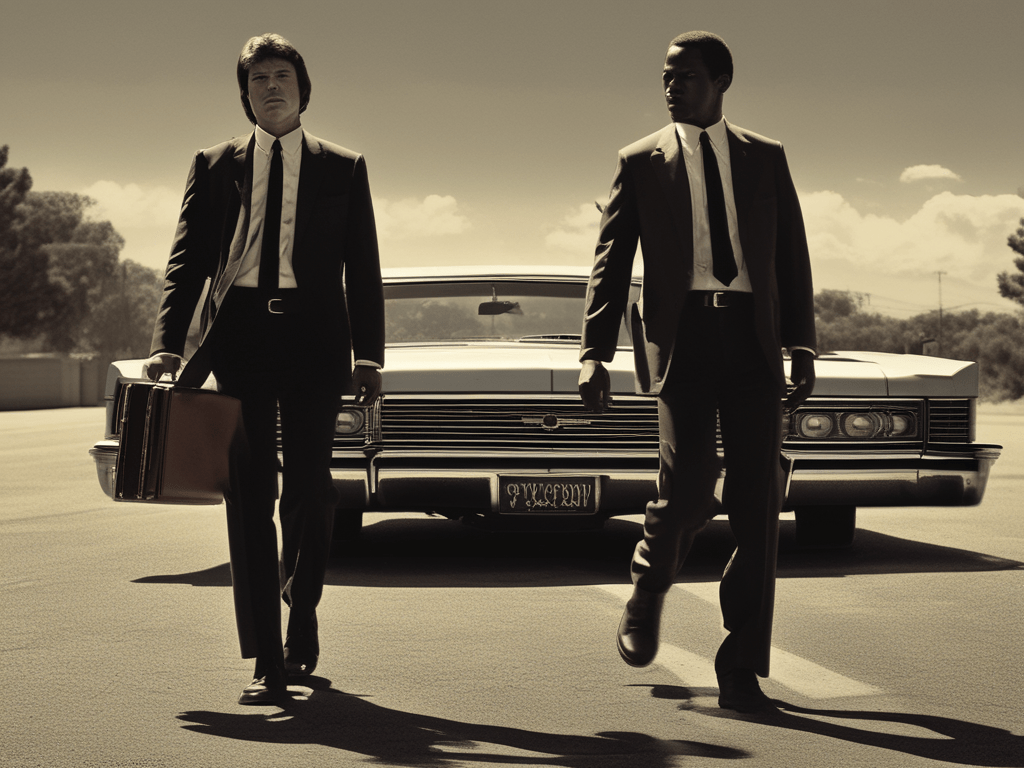
Imagine a movie that throws you into a blender with a motley crew of hitmen, a down-and-out boxer, a seductive femme fatale, and a couple of amateur robbers, all while shaking you up with rapid-fire dialogue, non-linear storytelling, and pop culture references sharper than a samurai sword. Welcome to “Pulp Fiction,” Quentin Tarantino’s magnum opus that redefined the crime genre and left an indelible mark on 90s cinema.
From the moment the iconic surf rock beat of Dick Dale’s “Misirlou” blasts through the speakers, you know you’re in for a wild ride. Tarantino, the maestro of chaos, orchestrates an intricate ballet of violence and humor, blending them so seamlessly that you can’t help but chuckle at the absurdity of it all. Who else could turn a simple conversation about the differences between European and American fast food into a tension-filled prelude to a hit job?
The writing is nothing short of genius. Tarantino’s script is a masterclass in dialogue—sharp, witty, and laden with references that range from the sublime to the ridiculous. Each character’s lines are crafted with such precision that they become instantly memorable. Whether it’s Jules’ biblical tirades, Vincent’s casual philosophising, or Mia’s cool detachment, every word feels meticulously chosen to enhance the film’s eclectic vibe.
The acting ensemble is a veritable who’s who of Hollywood heavyweights, each bringing their A-game. John Travolta’s career-resurrecting turn as the laid-back Vincent Vega is a joy to watch, while Samuel L. Jackson’s portrayal of Jules Winnfield is nothing short of iconic. His delivery of the Ezekiel 25:17 speech is the stuff of cinematic legend. Uma Thurman exudes a dangerous allure as Mia Wallace, and Bruce Willis delivers a surprisingly nuanced performance as the brooding boxer, Butch Coolidge.
Cinematographically, “Pulp Fiction” is a feast for the eyes. The camera work is dynamic yet precise, capturing the essence of every scene with a keen eye for detail. From the adrenaline-pumping needle scene to the serene tranquility of Butch’s escape, every shot is a testament to Tarantino’s visual storytelling prowess. Andrzej Sekuła lensed the picture, as he did for Tarantino’s other seminal masterpiece: Reservoir Dogs.
The editing, by Sally Menke, deserves a standing ovation. The film’s non-linear narrative could have been a disjointed mess in lesser hands, but Menke’s expert pacing ensures that each storyline weaves into the next with a rhythm that’s both unpredictable and satisfying. The seamless transitions between different timelines and perspectives keep the audience engaged and on their toes.
In conclusion, “Pulp Fiction” is a cinematic roller coaster that leaves you breathless, bewildered, and begging for more. It’s a film that defies conventional storytelling and invites you to revel in its eccentricities. Tarantino’s audacious vision, coupled with stellar performances and impeccable craftsmanship, makes “Pulp Fiction” a timeless classic.
Scores (out of 5)
• Directing: 5/5
• Writing: 5/5
• Acting: 5/5
• Cinematography: 5/5
• Editing: 5/5
• Overall Film: 5/5
Final Verdict
“Pulp Fiction” is not just a movie; it’s an experience—an intoxicating blend of wit, violence, and sheer brilliance that cements its place in the pantheon of great films.


 Proverbial Films