
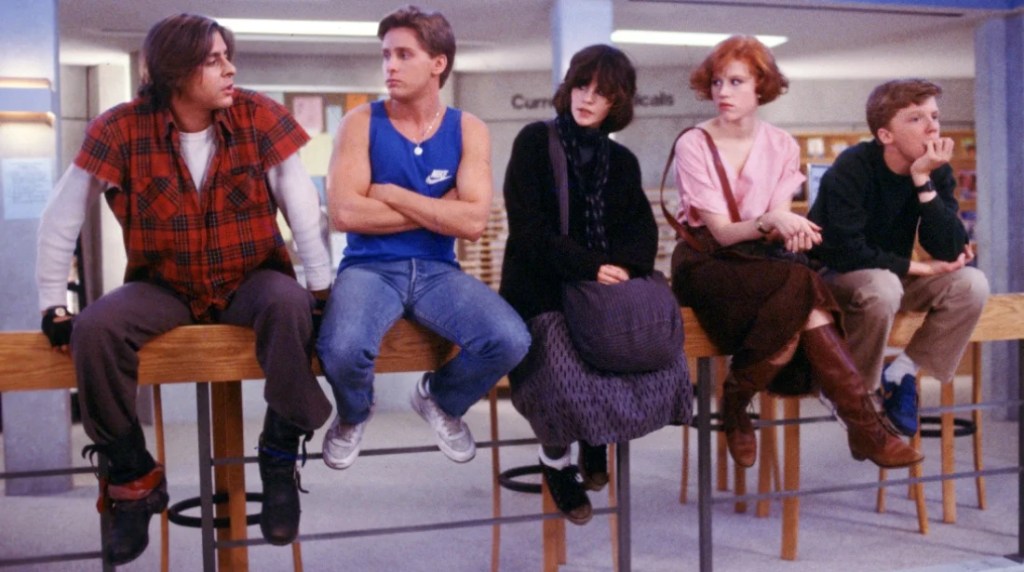
John Hughes’ 1985 classic, The Breakfast Club, is more than just a film—it’s a cultural touchstone that has resonated with generations of audiences. With its sharp writing, memorable characters, and an insightful exploration of the teenage experience, the film captures the struggles, fears, and hopes of adolescence in a way that remains deeply relatable. It’s a coming-of-age story that strips away the facades we build around ourselves, revealing the complex and often contradictory individuals beneath.
The premise of The Breakfast Club is deceptively simple: five high school students from different cliques are forced to spend a Saturday in detention together. Over the course of the day, they move from mutual antagonism to a profound understanding of one another. Hughes’ direction is understated yet effective, allowing the characters and their interactions to take center stage. The setting—a single location in the school’s library—creates a sense of confinement that mirrors the emotional barriers the characters must break through.
The writing is where Hughes truly shines. The dialogue is witty, incisive, and, at times, painfully honest. Hughes captures the distinct voices of each character, from the jock to the brain to the rebel, while also highlighting the universal themes that connect them. The film’s exploration of identity, peer pressure, and the fear of being misunderstood is conveyed with a sensitivity and depth that elevates it above the standard teen fare. Lines like, “We’re all pretty bizarre. Some of us are just better at hiding it, that’s all,” encapsulate the film’s central message: that we all carry hidden burdens and insecurities, regardless of how we present ourselves to the world.
The acting ensemble is nothing short of iconic. Each member of the “Brat Pack” brings their character to life with nuance and authenticity. Emilio Estevez as the athlete Andrew, Molly Ringwald as the princess Claire, Judd Nelson as the rebel Bender, Ally Sheedy as the outcast Allison, and Anthony Michael Hall as the brain Brian—each actor embodies their role so completely that it’s impossible to imagine anyone else in these parts. The chemistry between the cast is palpable, and their performances anchor the film’s emotional arc, making the characters’ transformations both believable and affecting.
Cinematography by Thomas Del Ruth is subtle yet effective, using the confined space of the library to reflect the characters’ emotional states. The camera work is unobtrusive, focusing on the actors and their expressions, which are crucial to conveying the film’s themes. The decision to shoot the film primarily in medium and close-up shots reinforces the intimacy of the story, drawing the audience into the characters’ personal journeys.
Editing by Dede Allen is seamless, ensuring that the film’s pacing never drags despite its limited setting. The transitions between moments of humor, conflict, and introspection are smooth, maintaining the film’s narrative flow. The editing also plays a crucial role in the film’s climax, where the characters’ confessions build upon one another, culminating in a cathartic release of emotion that feels both earned and inevitable.
The soundtrack, featuring tracks like Simple Minds’ “Don’t You (Forget About Me),” is the perfect accompaniment to the film’s themes of youth and rebellion. The music not only captures the spirit of the 1980s but also underscores the film’s emotional beats, making it an integral part of the viewing experience.
In conclusion, The Breakfast Club is a timeless exploration of teenage angst, identity, and the struggle to be understood. Hughes’ direction, combined with a sharp script and stellar performances, creates a film that is both entertaining and deeply moving. It’s a film that speaks to the adolescent in all of us, reminding us that no matter how different we may seem, we all share the same fears, hopes, and desires.
Scores (out of 5)
- Directing: 5/5
- Writing: 5/5
- Acting: 5/5
- Cinematography: 4/5
- Editing: 5/5
- Overall Film: 5/5
Final Verdict
The Breakfast Club is a masterpiece of the teen genre, offering a poignant and perceptive look at the complexities of growing up. It’s a film that has stood the test of time, continuing to resonate with audiences of all ages. By the end of this Saturday detention, you’ll realize that we’re all a little bit of a brain, an athlete, a basket case, a princess, and a criminal—and that’s what makes us human.t recesses of the human soul. It is a film that challenges its audience, forcing them to confront the unbearable and the unimaginable. For those with the fortitude to endure it, “Martyrs” offers a profound and disturbing exploration of pain and transcendence that is as unforgettable as it is unrelenting.


 Proverbial Films
Leave a comment