
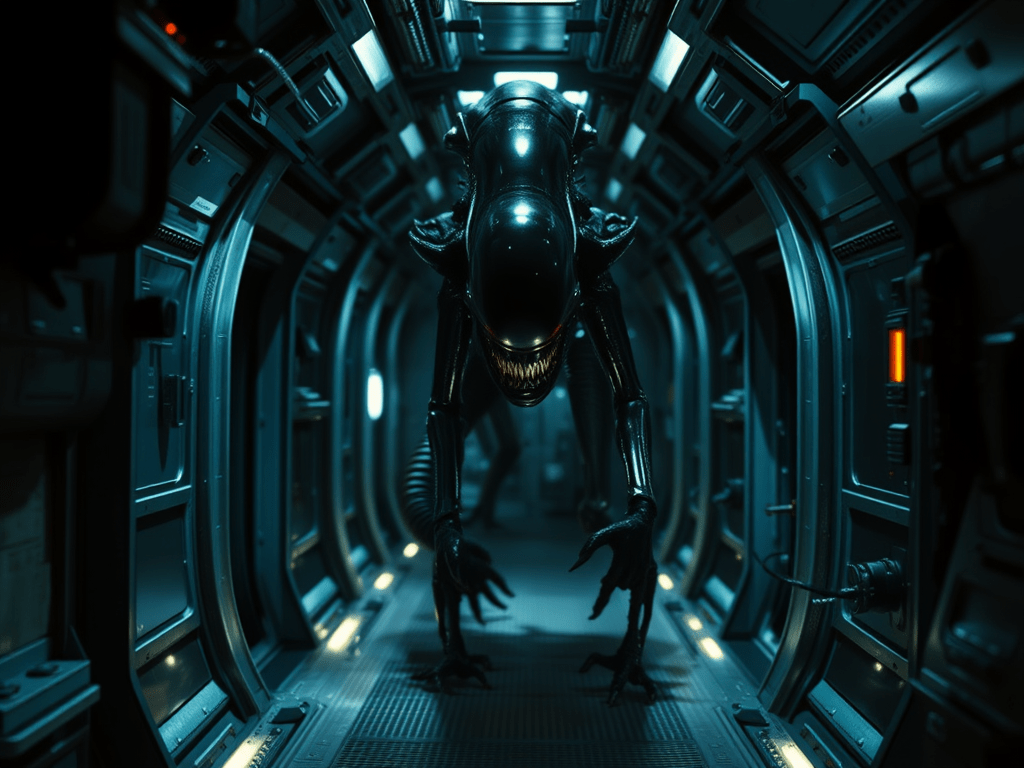
Ridley Scott’s Alien is not just a sci-fi horror classic—it’s the sci-fi horror classic. A masterstroke of atmospheric tension, claustrophobic dread, and cold, industrial terror, Alien took the “haunted house in space” concept and elevated it to operatic levels of suspense. Released in 1979 and still unnervingly effective today, it’s a film that doesn’t just want to scare you—it wants to inhabit you, like the titular xenomorph burrowing deep into your chest cavity.
The story begins with the commercial space tug Nostromo intercepting a distress signal from a mysterious planetoid. When the crew investigates, they bring back more than they bargained for: a parasitic alien lifeform that begins to systematically eliminate them one by one. What follows is a slow-burning descent into primal fear, as the crew battles an enemy that is at once biological, unknowable, and terrifyingly efficient.
Ridley Scott’s direction is a symphony of stillness and shadows. The first half of the film moves with a deliberate pace, letting the audience marinate in the eerie hum of the Nostromo and the mundane tedium of deep-space trucking. Then, with a single explosive chestbursting scene, it transforms into a relentless nightmare. Scott never rushes. He builds mood with surgical precision, allowing each corridor, beep, and breath to amplify the tension until it’s unbearable. The result is a film that feels oppressive—in the best possible way.
Dan O’Bannon’s screenplay, paired with creature concepts by H.R. Giger, is minimalist but razor-sharp. The characters feel grounded and believable, blue-collar space workers just doing their jobs—until their job becomes survival. The dialogue is casual, even mundane, which makes the terror feel all the more real when it invades their otherwise functional world. There’s no grandiose exposition dump, no heroic one-liners—just people caught in an escalating nightmare.
Sigourney Weaver, in her breakout role as Ripley, is nothing short of iconic. Initially one voice among many, Ripley slowly emerges as the film’s moral and emotional center. She’s practical, smart, and human—not an invincible action hero, but a woman doing everything she can to survive. Weaver’s quiet strength becomes the film’s backbone. Meanwhile, Ian Holm gives a brilliantly eerie turn as the science officer Ash, whose character twist mid-film adds a whole new layer of unsettling intrigue. And let’s not forget Yaphet Kotto and Harry Dean Stanton, who bring gritty, grounded realism to the doomed crew.
But the real star—the nightmare fuel that has haunted audiences for decades—is the xenomorph itself. Giger’s biomechanical design is unlike anything else in cinema: phallic, skeletal, insectoid, and malevolent. It’s not just a monster—it’s a cosmic horror, a sleek engine of death with no motive other than survival and reproduction. From facehugger to chestburster to full-grown terror, each form of the alien lifecycle is a set piece in evolutionary horror.
Cinematography by Derek Vanlint is stark and elegant. The Nostromo is filmed like a decaying cathedral—massive, dark, and oppressive. The dim lighting, steam-filled hallways, and flashing emergency strobes create an atmosphere of constant unease. The film’s production design also deserves applause: industrial, utilitarian, and coldly real, it makes the sci-fi setting feel lived-in and tangible.
Terry Rawlings’ editing is meticulous. He draws out suspense with long takes and restrained pacing, letting the audience’s imagination do half the work. When violence comes, it’s fast and shocking, creating a jarring contrast that only enhances the horror. The silence of space is weaponized, punctuated only by the ambient creaks of the ship or the sudden screech of the alien’s attack.
And then there’s Jerry Goldsmith’s score—equal parts classical and chaotic, eerie and explosive. The music feels alien itself, crawling under your skin and merging seamlessly with the film’s sound design to create an audio experience that’s every bit as disturbing as the visuals.
Scores (out of 5)
- Directing: 5/5
- Writing: 4.5/5
- Acting: 5/5
- Cinematography: 5/5
- Editing: 5/5
- Overall Film: 5/5
Final Verdict
Alien is a slow, suffocating descent into terror—a film that redefined not just science fiction but horror itself. Ridley Scott’s direction, paired with unforgettable performances and one of the most iconic creature designs in film history, creates an experience that’s as unsettling today as it was in 1979. It’s not just a movie—it’s a warning: out there in the void, you’re alone, and something might be waiting. Watching. Drooling.
And it’s not in a hurry.
It’s already inside..

 Proverbial Films