
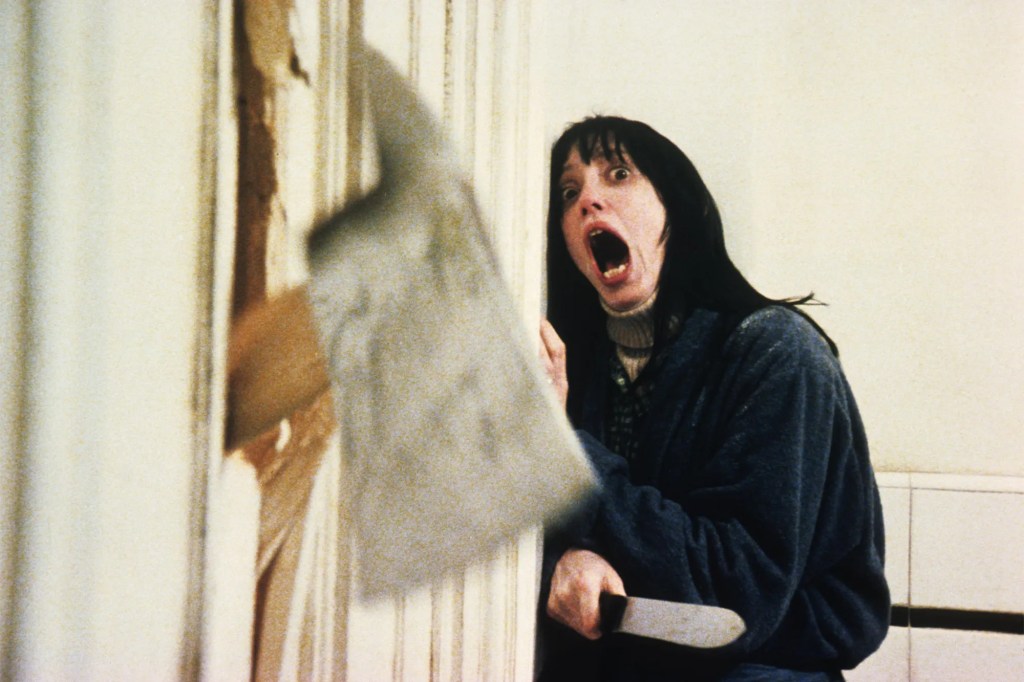
Stanley Kubrick’s The Shining (1980) is a psychological horror masterpiece that transcends its genre, offering not just scares but a chilling descent into the fragility of the human mind. Adapted from Stephen King’s novel (with significant deviations), the film combines Kubrick’s meticulous craftsmanship with Jack Nicholson’s unhinged performance to create an unforgettable cinematic experience. It’s a film that crawls under your skin and lingers there, much like the haunting halls of the Overlook Hotel.
The story is deceptively simple: Jack Torrance (Jack Nicholson), an aspiring writer, takes a job as the winter caretaker of the isolated Overlook Hotel. He brings along his wife Wendy (Shelley Duvall) and son Danny (Danny Lloyd), hoping for a fresh start. But as the snow traps them inside, the hotel’s dark history begins to unravel Jack’s sanity, while Danny’s psychic abilities—his “shining”—reveal the horrors lurking in the shadows.
Kubrick’s direction is a masterclass in atmosphere and tension. Every frame is composed with precision, from the iconic Steadicam shots that glide through the Overlook’s corridors to the slow zooms that create an oppressive sense of dread. The Overlook Hotel itself becomes a character, its sprawling halls and labyrinthine layout reflecting the disintegration of Jack’s mind. Kubrick’s ability to let the horror simmer, punctuated by explosive moments of violence and madness, ensures that the audience is never truly at ease.
The writing, heavily reimagined from King’s source material, distills the novel’s essence while leaning into Kubrick’s trademark ambiguity. The film eschews clear explanations for the Overlook’s supernatural happenings, leaving viewers to interpret its mysteries for themselves. This lack of resolution might frustrate some, but it’s precisely what gives The Shining its enduring appeal—a puzzle box that rewards repeated viewings.
Jack Nicholson’s performance is electrifying. His portrayal of Jack Torrance starts with an unsettling intensity and escalates into full-blown mania, his deranged expressions and sardonic delivery making him both terrifying and fascinating to watch. Shelley Duvall, often overshadowed in discussions of the film, delivers a raw, vulnerable performance as Wendy, capturing the terror and helplessness of a woman trapped with a man unraveling before her eyes. Danny Lloyd, as young Danny, gives a remarkably natural performance, his quiet fear amplifying the tension.
Cinematography by John Alcott is stunning, using symmetry and bold color palettes to create a dreamlike quality that veers into the nightmarish. The blood-red elevator scene, the desolate hedge maze, the eerily lit Gold Room—all are indelible images that have become part of cinema’s visual lexicon. The Steadicam shots, revolutionary at the time, immerse the audience in the hotel’s unnerving vastness, making them feel as trapped as the Torrance family.
Editing by Ray Lovejoy is pitch-perfect, balancing the film’s deliberate pacing with moments of explosive chaos. The cross-cutting between Jack’s descent into madness, Danny’s supernatural visions, and Wendy’s growing fear creates a rhythm that keeps the audience on edge. The use of title cards for “Tuesday” or “Wednesday” heightens the sense of disorientation, as time in the Overlook seems to stretch and collapse in on itself.
And then there’s the sound design—a symphony of unease. The discordant score by Wendy Carlos and Rachel Elkind, combined with unnerving diegetic sounds like typewriter clacks or Danny’s Big Wheel trundling over the hotel’s floors, creates an auditory landscape that amplifies the film’s dread.
In conclusion, The Shining is more than a horror film; it’s a deep dive into the human psyche, an exploration of isolation, madness, and the ways in which we’re haunted by our own demons. Kubrick’s meticulous direction, combined with unforgettable performances and striking visuals, makes it a film that remains as unsettling today as it was over 40 years ago.
Scores (out of 5)
• Directing: 5/5
• Writing: 4.5/5
• Acting: 5/5
• Cinematography: 5/5
• Editing: 5/5
• Overall Film: 5/5
Final Verdict
The Shining is a haunting masterpiece, a film that defies easy categorization and leaves an indelible mark on its viewers. It’s a chilling exploration of madness, mystery, and malevolence, set in one of the most unforgettable locations in cinematic history. Whether you interpret it as a ghost story, a psychological thriller, or an allegory, one thing is certain: the Overlook Hotel will stay with you long after you check out.
myriad flaws into an unforgettable viewing experience. It’s a film that shouldn’t work on any level, and yet, in its own twisted way, it does. Watch it with friends, a strong drink, and a sense of humor—this is one cinematic experience you won’t soon forget.yrs” offers a profound and disturbing exploration of pain and transcendence that is as unforgettable as it is unrelenting.




Leave a Reply